On the side-lines of the Sydney Haematology meeting
which I attended in February 2024
Dr. P K Sasidharan
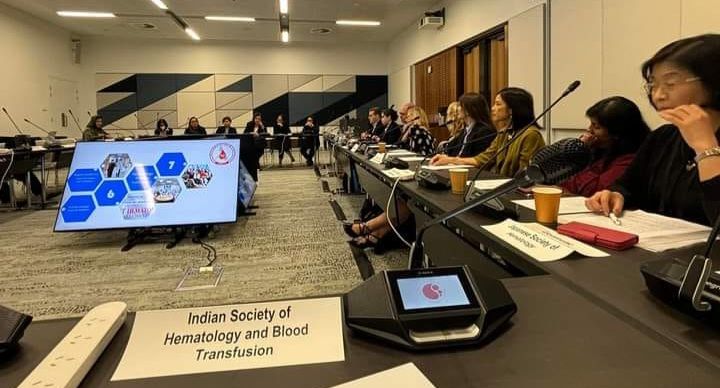
Incidentally I got the opportunity to represent Indian Society of Haematology at the international conference organised jointly by American Society of Haematology (ASH) in association with New Zealand and the Australian Society of Haematology at Sydney in February. Prior to the formal conference, attended by 400 delegates, there was a meeting of the presidents of all the partner societies. There were 16 partner countries, they were USA, Australia, New Zealand, India, Pakistan, Bangladesh, Sri Lanka, Malaysia, Indonesia, Philippines, Singapore, Vietnam, Taiwan, Hong Kong, Japan and Thai Land. There was no representation from China. After the partner society meeting, where I presented activities of Indian Society of Haematology, incidentally on the side-lines the Pakistan representative, an army doctor Dr (Brig) Mehreen Ali khan, and the Bangladesh representative Dr(Brig) Abiden Mustafa took selfies with me and the American Society representative Michelle.
On the side-lines, I discussed and reminded them of the need for regional coordination and cooperation to strengthen the health systems of Asian countries with a strong primary care rather than following USA blindly, as is being done now. Mind you, USA still does not have a good health system, or they have the worst system among the developed nations, whereas Australia, New Zealand, all the Scandinavian countries and Canada have excellent systems. The USA representative too endorsed my views, and all agreed that India, Pakistan, Sri Lanka, and Bangladesh should not copy the USA model. My viewpoint, that I could develop, was possible only because of the kind of haematology work that I had done at Calicut, where I was primarily looking after general medicine and as an extra work only looked after haematology problems, which seldom happens now. Now everyone gets transformed prematurely into single system specialist with hardly any opportunity to understand the nuances of clinical medicine and clinical skill. They forget the fact that only a good generalist can become a good specialist as well.
I never even thought of becoming a haematologist or any other single system specialist when I started my career. Sensing the danger, in fact I decided against focusing on one speciality alone during my MD training at PGI and came back and started working in General Medicine department at Calicut Medical College, a museum of all diseases. At Calicut, Prof KA Salim was my unit chief. Pof Salim was a consultant hematologist in UK and when he came back to Kerala the government requested him to start haematology department, but he preferred to be in internal medicine- the same thought which I too had. Our medicine unit started getting all the haematological problems including leukaemia from all over Kerala since those days even RCC was not looking after haematological malignancies like leukaemia. That kind of specialisation (internal medicine + one speciality) truly helps the doctors to develop and nurture the most necessary clinical skill and certainly helped the society better.
Throughout my career, haematology work was less than 25% of my overall clinical work, except probably towards the fag end of my tenure at Calicut. That kind of work gave me better insight into the social problems associated with illnesses and the much essential clinical skill to diagnose and manage all diseases. To practice haematology as a speciality we need tremendous clinical skill which is never attained with premature specialisation.
My haematology work was recognised by the haematologists all over India and that has culminated now in making me the president of the Indian Society of Haematology, though I have stopped focussing on haematology in my clinical practice. Why I am writing this is to caution the new entrants in the medical profession, that specialisation should be need based (need of the society and the institution to which you belong) or incidental rather than planned right from day of joining MBBS. Premature specialisation spoils the true doctor in you, and many are made to work often like a robot, which follows the programs fed into it, without looking to the peripheries and the social issues. In countries with good health systems, they are fortunate to have a strong primary care which takes care of all common ailments including haematological problems and the patients often arrive with a labelled diagnosis to the specialist. In those countries with good health systems, the specialist seldom must face the challenge of evaluating undifferentiated clinical problems.
Imagine our situation where there is no good health system with trained family doctors, and the patients are allowed to go doctor shopping to the numerous single system specialists, a situation that never happens in these countries with better financial resources.
My advice to the new gen MBBS graduates- you have umpteen opportunities waiting for you as GPs/family doctors- try to become one at the earliest. To the policy makers – please scale up training programs in family medicine because, people need them and MBBS is not enough to transform them into competent and confident family doctors.